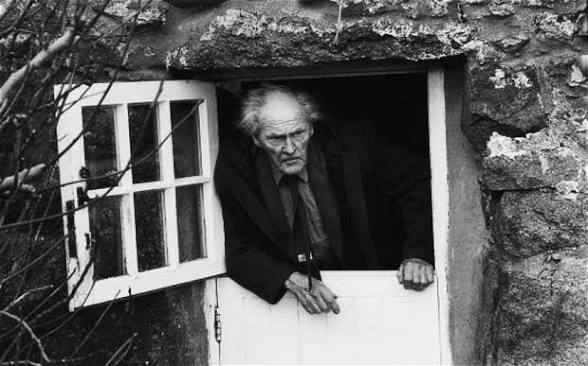
I Was the Vicar of Large Things
By R S Thomas
I was vicar of large things
in a small parish. Small-minded
I will not say, there were depths
in some of them I shrank back
from, wells that the word “God”
fell into and died away,
and for all I know is still
falling. Who goes for water
to such must prepare for a long
wait. Their eyes looked at me
and were the remains of flowers
on an old grave. I was there,
I felt, to blow on ashes
that were too long cold. Often,
when I thought they were about
to unbar to me, the draught
out of their empty places
came whistling so that I wrapped
myself in the heavier clothing
of my calling, speaking of light and love
in the thickening shadows of their kitchens.
After a poetry discussion in the BPA poetry group I thought about this RS Thomas poem as it traces a failed knowledge, and the question for me is the fall about the priest and his failing faith or his uninspired parishioners? Obviously it has reverberations to the psychoanalytic Heineken like task of reaching the parts that others don’t reach.
The priest comes to his parishioners wanting what any of us analysts may want and that’s live or authentic contact with another person’s interior life. He ostensibly wants to help convert raw, unprocessed beta suffering into something that can be symbolised, something that can be carried but finds instead is that this isn’t possible not because anyone is resisting him but due to something more archaic than that.
So the wells that his words fall into and dies within aren’t receptive containers, just receivers of understandings they can’t metabolise. Theres no internal objects there that could catch the word and let it reverberate and come back changed. What Bion described as attacks on linking is present, though not in the envious form we associate with more disturbed patients.
This is quieter and far more desolate, these are psyches that were never sufficiently responded to and the linking function has atrophied over time and the embers aren’t just cold but have lost the capacity to respond. Chilly stuff.
That image of the eyes as remains of flowers on an old grave is spot on. These are not eyes that are refusing contact but withdrawn, gradually, over a very long time as in object loss that was never really mourned, because mourning requires there to have been enough investment for grief to form in the first place? The flowers were real once but the grave is very old.
Thomas’s parishioners seem to inhabit a place in which the object was never sufficiently alive to grieve. You can’t mourn what was never quite there.
When the priest moves toward them, “when I thought they were about to unbar to me,” that’s the clinical moment we all know. The patient seems to reach the threshold and be about to open and then what you get is not warmth but a draught from empty places.
The contact that seemed possible is instead, the depth of the vacancy. There’s something like projective identification operating but what gets expelled is not unbearable content but something closer to a negative, the cold from rooms that were never furnished. The priest experiences nameless dread, not a specific terror, but the vertiginous exposure to absence itself.
The vestments passage is rather moving. “I wrapped myself in the heavier clothing of my calling” is almost a textbook description of what we do when we’re not ourselves contained. The role becomes the protection and he speaks of light from the formal requirements of his vocation, a scaffolding erected precisely where authentic connection has failed to materialise.
Any analyst who has worked with severely withdrawn patients will recognise those sessions where you keep speaking not because the words are landing but because silence would feel like abandonment. Presence without content is sometimes the only thing left to offer.
Thomas puts all of this not in a theological landscape but in the domestic space of primary care, in kitchens and living rooms. Which tells us that what’s really at stake isn’t intellectual doubt but a wound at the level of earliest experience.
The God or good object who falls into the well and disappears is partly the early object whose reliability could never be internalised. The spiritual and the relational shadow one another throughout, without the poem ever making that explicit.
What the poem finally describes is the experience of maintaining an analytic or spiritual position toward chronic non-response. Continuing to bring alpha function to material that cannot be dreamt.
The priest’s faith, what survives of it is the capacity to remain present to absence. To stay in the room when the room offers nothing back, as Bion meant in his late work about the analyst’s tolerance of not-knowing, about negative capability in clinical work.
Or is it the priest projecting his own dead flowers of his falling faith into his parishioners.
David Morgan
(Thanks to Joscelyn Sally Alan Louise Aleksandra Gillian and Helen in the SIG BPA Poetry group).